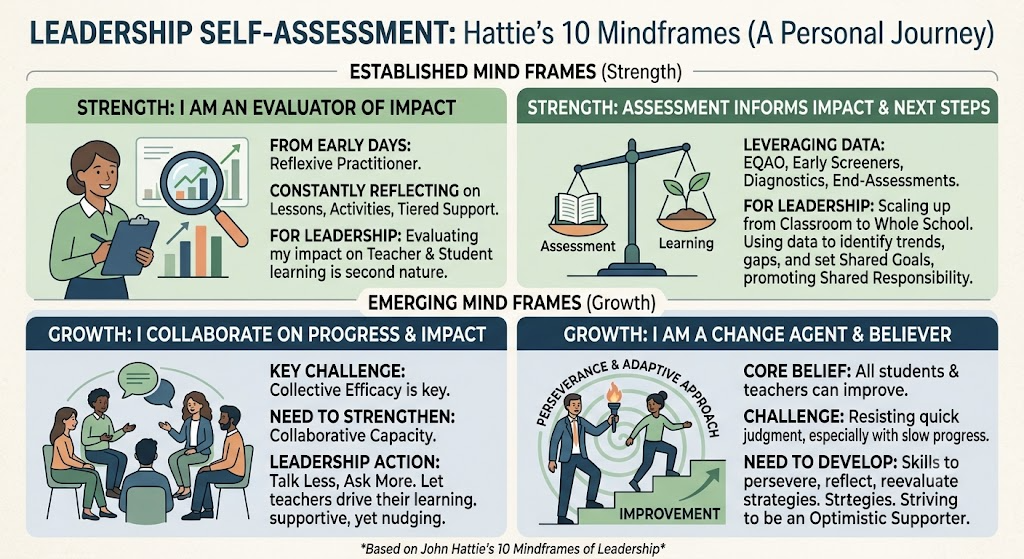
The Education Act meets School Reality
As school leaders, we are guided by the Ontario Leadership Framework, and held to the legal responsibilities and policies of the Education Act. Using Personal Leadership resources (i.e., problems solving skills, maintaining calm, developing solutions), it is essential that we execute our legal mandate while preserving a positive, inclusive, and equitable school culture. In the scenario below, the OLF domain, Building Relationships and Developing People, emphasizes the importance of building relationships with the staff, the students, the families, and the community as an essential part to student wellbeing and academic success. In addition, creating and maintaining a safe and healthy environment for students to learn and for staff to work in is the shared responsibility of school leaders and staff. This requires school leaders and teachers to use the school’s code of conduct, as well as the policies in the Education Act, along with creative problem solving, empathy, trauma-informed and restorative practices to support students in rebuilding relationships, addressing the hurt and harm, preserving dignity while still ensuring that behaviour expectations are upheld.
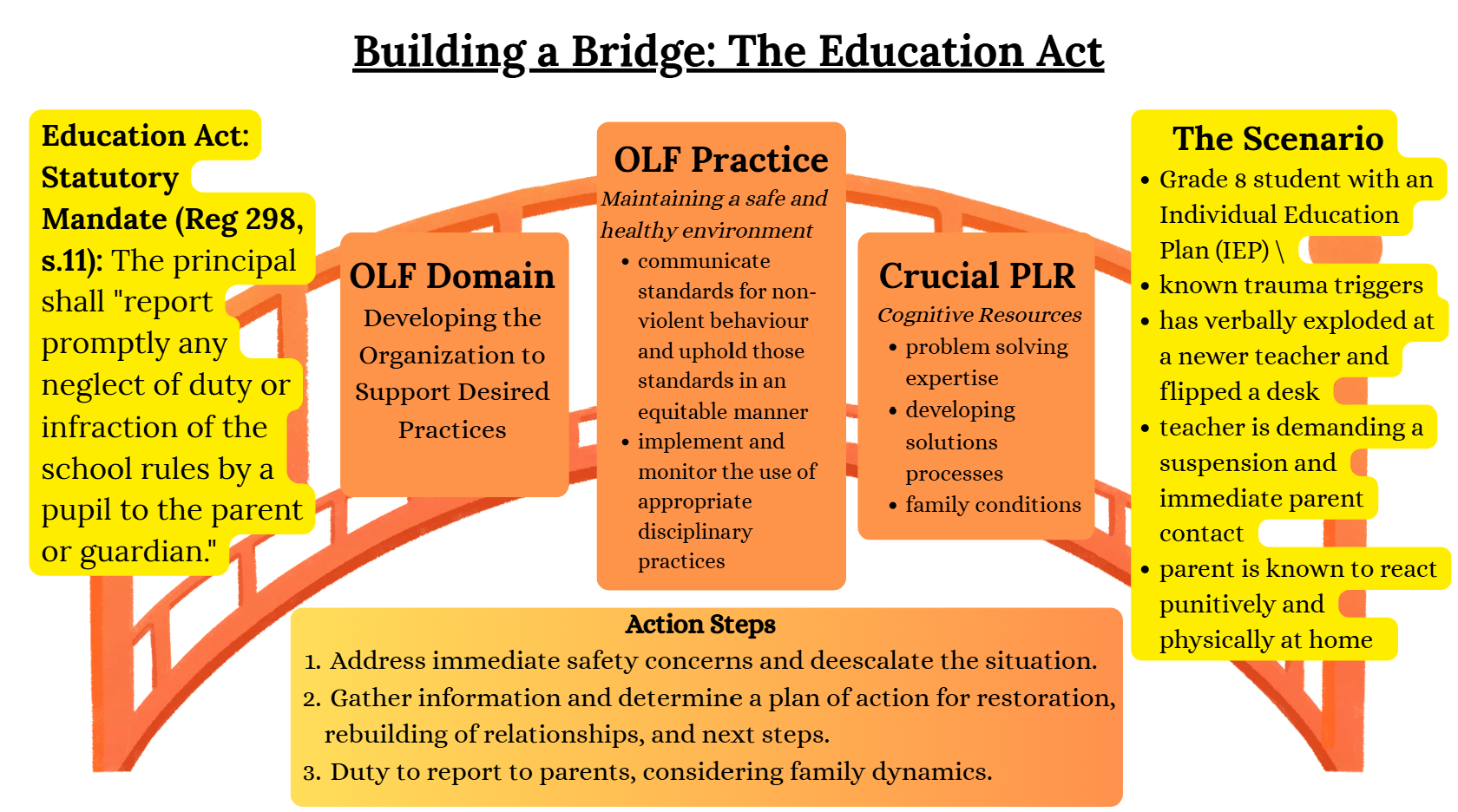
Bridging Instructional Science and Leadership Action
As a school leader, the primary goal is to improve instructional practices in order to improve student achievement. Below is a road map of the journey from a common instructional gap, through the cognitive science that corrects it, applying specific leadership actions that I would take to align resources and culture, and then arriving at the desired outcome. The instructional gap that I identified at my school was ‘wasted instruction time minutes’ due to a high number of bathroom breaks, purposeless free time, unguided projects, and learning tasks lacking rigor or curriculum fidelity. Using Rosenshine’s Principles of Instruction, Sweller’s Cognitive Load Theory, and Tharby and Allison’s Making Every Lesson Count, a clear direction for leadership actions for reducing wasted instructional minutes can be implemented. To facilitate change, building relationships and trust with educators in order to be able to engage in courageous conversations and after implementation of new strategies, follow up conversations with the teacher, are essential for nudging educators along in the same direction of excellent instructional practices.
How will I ensure my leadership practices genuinely embody the partnership principles of equality, dialogue, and reciprocity to build a safe, trusting culture where teachers drive their own professional growth?
With the Ontario Leadership Framework as my roadmap, and equity, instructional leadership, and high expectations for all, as my foundation, I am ready to take the next step in my leadership journey. As I transition into a leadership role, I desire to lead with an adaptive approach, which requires social interaction, building relationships and trust with educators, engaging stakeholders in shared goals, and creating the conditions for a posture of collective responsibility for student success. An adaptive approach to leadership requires leading with my heart, not just my head, where decisions are made by looking at situations ‘from the balcony, not the dance’, in the words of Ron Heifetz, understanding the mitigating circumstances, and collaborating with educators and the whole school community. It means leading with high expectations, delegating effectively to promote teacher leadership, and encouraging those who challenge, to rethink the issue at hand. As a life long learner and someone who is passionate about student well being and student success, I strive to lead by example, encourage risk taking, and create the conditions for all those I lead to grow and succeed.
According to Jim Knight’s principles of a partnership approach, equality is the foundation on which all other principles rest upon. The idea that principals and teachers share ideas and make decisions together as equals, is an approach to leadership where Knight’s research found that teachers were four times more likely to act on what they learned. With that in mind, a shared leadership stance where teachers are empowered to take on leadership opportunities, is one that I will take. The ability to leverage teachers’ strengths and expertise in order to build a school culture of shared responsibility for the student success, increase the proficiency and mastery of teachers instructional excellence, and promote the collective efficacy of teachers, are important aspects of shared leadership. To cultivate equality in a school culture, it is important for me to be open, vulnerable, transparent, and be willing to ask for and receive feedback. In order to create a sense of equality amongst staff, it’s important to lead by example, build strong relational trust with teachers, get involved in co-planning and co-teaching with them, and be present and visible throughout the school day.
Another important principle to a partnership approach to leadership, according to Knight, is dialogue. Dialogue, by definition, is a cooperative, intentional exchange where the goal is mutual understanding and sharing perspectives. Being intentional about dialogue, or exchanges between teachers and principal, can be done by increasing my visibility throughout the school day. Spending time in the halls, outside at recess, and in classrooms creates the conditions for relationship building and support for students and teachers. Regular walkthroughs that are non-evaluative and informal, where timely feedback can be offered, is another way to promote dialogue in a partnership approach. When engaging in conversation with teachers, it’s important to speak with clarity and listen with intent, communicate frequently, be less telling and more asking, less evaluative and more helpful, in order to create a culture of trust, true partnership, and equality.
Finally, the principle of reciprocity is an important one in a partnership approach to leadership. In Knight’s words, “when one teaches, two learn,” and that shared learning is what separates partnership leadership from any top-down improvement model. As a leader, I am not the expert of all things, and I can learn from the expertise of other educators. It is not a job I can do alone. When having a partnership approach, it’s essential that teachers are in the driver’s seat for their own learning and determine the goals they have for their own professional learning, while I take a supportive role and offer guidance to help them achieve those goals. It is my role to create the conditions for collective efficacy where teachers believe that their collective efforts can positively influence student learning. By making time and space for collaborative teacher inquiry, creating leadership opportunities to enable mastery experiences, teachers and school leaders can learn from each other. It is my role to support teachers’ engagement in collaborative inquiry by creating the conditions for teachers to build relational trust and learn from one another, promote a culture of collective ownership over student achievement and infuse joy into all that we do.
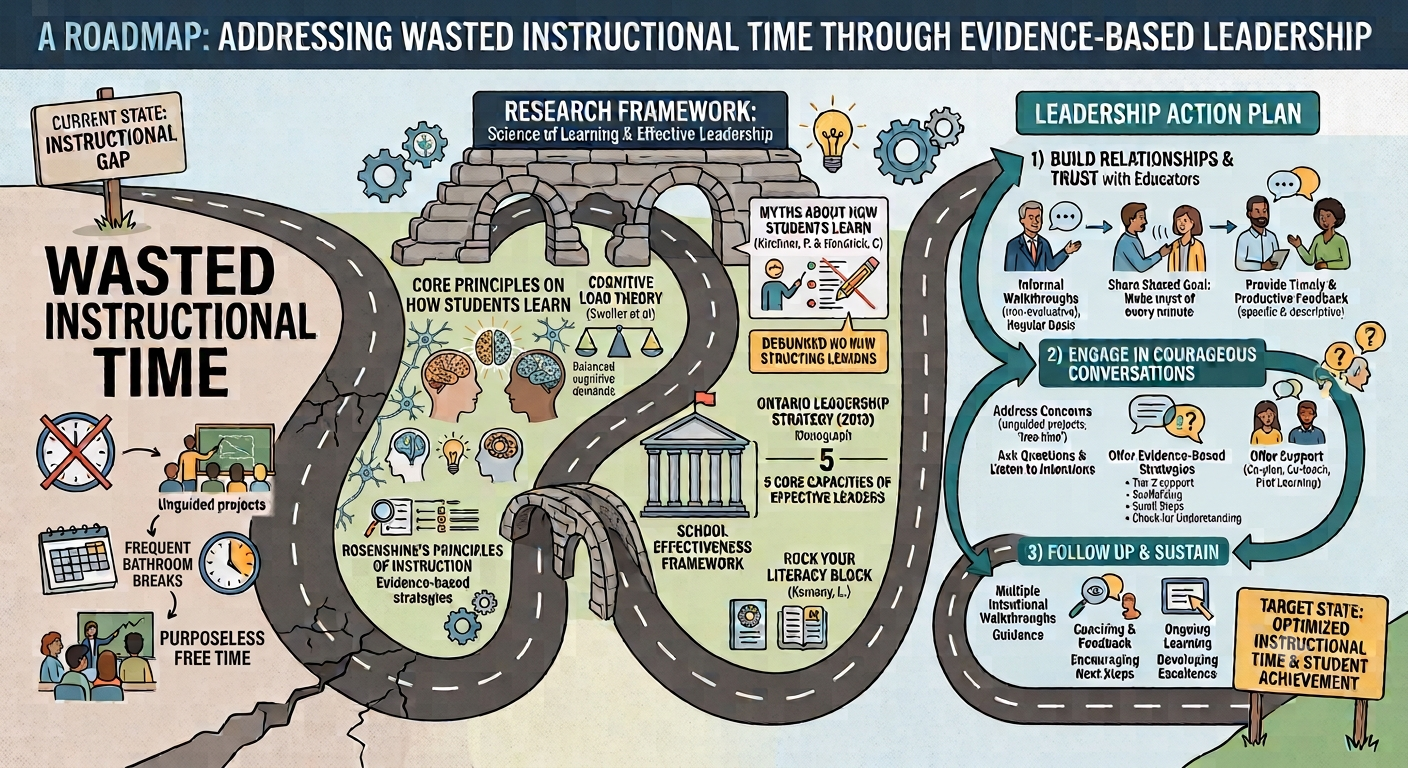
An Adaptive Approach to AI Use in the Classroom
Using Ron Heifetz’s Adaptive Leadership Framework as a guide, I have examined the issue of appropriate student use of AI in middle school classrooms. In my current school, every student in grade 6, 7, and 8 has access to a chromebook and most students use it all day, for all subject areas, for every assignment. At the beginning of the year, all students learn about digital citizenship and the appropriate use of a chromebook, including the use of AI, and sign a contract that states that they will adhere to the school’s policies around the use of technology. However, the concern from teachers in these classes is that the use of AI to complete assignments as ‘cheating’ is happening all the time, and it is challenging and time consuming for teachers to police. Rather than banning devices, teachers must integrate AI with clear boundaries, teaching its use as a tool. Leaders should manage teacher distress through ongoing professional learning, starting with practical strategies to reduce administrative loads. Leveraging tech-savvy staff via mentorship, open-door visits, and lunch-and-learns builds capacity within the staff. Managing distractions requires intentional device routines, such as screen modes, and shifting focus from policing to modeling proper use. Finally, addressing teacher skepticism through active listening, casting a clear shared goal, and co-creating boundaries, fosters appreciation for AI’s positive capabilities for student use in the classroom.
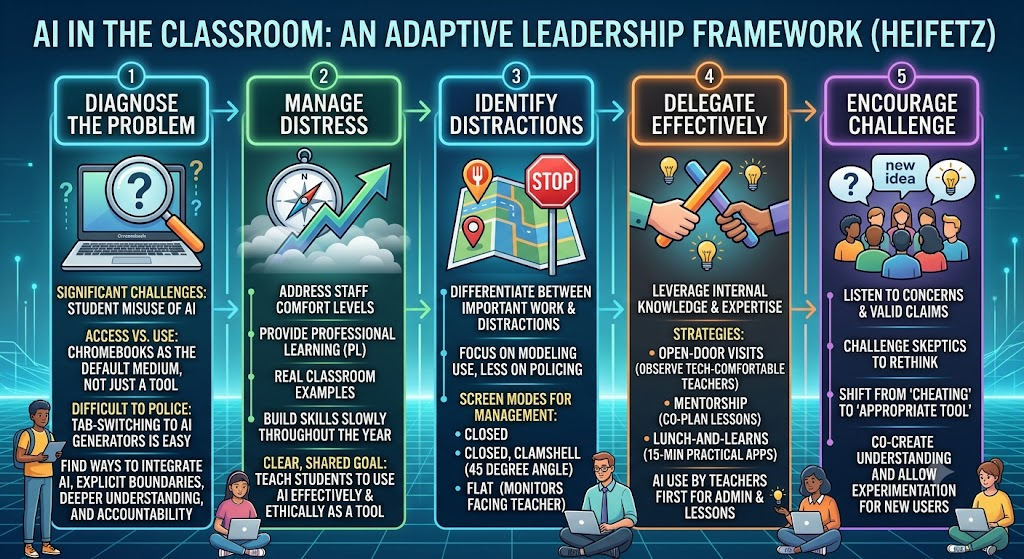
John Hattie’s 10 Mindframes for Leadership: A Self-Reflection
Using John Hattie’s 10 Mindframes of Leadership as a self-assessment tool, I have reflected on my own leadership experiences in my school. I have identified two mindframes that I have significantly developed during my previous years of teaching and two mindframes that I am looking to strengthen as I continue on my leadership journey. First, my strengths lie in my ability to be a reflective practitioner as it is second nature to me to constantly be reflecting on my teaching practice, the impact of my lessons, activities, and tiered support on student success. As a result, being an evaluator of my impact on teacher learning, reflecting on my leadership practices, will be a natural part of my thinking process. In addition, using assessment to inform my own practices and to inform next steps is a mindframe I have consistently relied on as a measure of impact on student learning (i.e., using EQAO data, early screeners, diagnostics, and unit-end assessments). Next, one of the two mindframes that require more time for strengthening as a future leader is collaborative inquiry, where my role as a leader is to talk less and ask more, allowing the teachers to be the drivers of their own professional learning, while I take a supportive role. Finally, a second mindframe of leadership that needs more time to develop is being an agent of change, believing that ALL teachers and students can succeed. The most important moral principle that compels me to do my job everyday, is the belief that all students can learn and have the right to learn. In a leadership role, this moral imperative must extend to teachers as well. As a leader with an adaptive approach, it’s important for me to strengthen the skills needed to persevere, continually reflect, and reevaluate strategies that are meant to help teachers improve their instructional practice. A creative problem solver, an optimistic supporter, and a genuine believer that every teacher can improve, is the type of leader I strive to be.