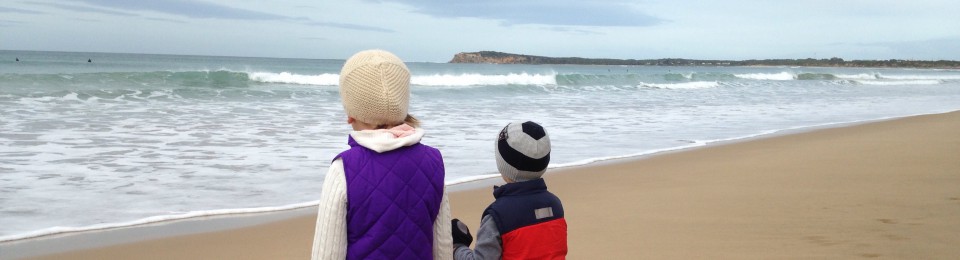


Our first stop was Port Arthur, about 100km from Hobart. Port Arthur is a place where Tasmania’s rich history comes alive. It is known as a former prison or penal colony, however, it was much more than just a prison. Back in the day, it was a complete community, home to military personnel and free settlers, in addition to the prisoners. The convicts worked in farming and industries, producing a large range of resources and materials. It was a place where parties were had, beautiful gardens were created to be enjoyed and where children played and attended school.


The Port Arthur penal station was established in 1830 as a timber-gathering camp, using convicts from England as labourers. In 1833, it was used as a punishment station for repeat offenders. Later on, it changed into a place where men could be reformed through discipline and punishment, religious and moral instruction, classification and separation, and training and education. By 1840, more than 2000 convicts, soldiers and civilians lived at Port Arthur which was a major industrial settlement at this time, producing everything from stone and bricks to furniture and clothing, boats and ships.


A short ferry ride from the site brought us to Isle of the Dead cemetery where deceased prisoners were buried and the site of the prison for the boys, where the boys were separated from the men prisoners to ensure their safety and proper treatment.


When convict transportation to Tasmania ended in 1853, Port Arthur became an institution for aging and physically and mentally ill convicts. In 1877, the penal settlement closed and later became a historic site.


Our first night in Tasmania, we stayed in Orford in a beautiful cottage on the river, about 100km north of Port Arthur and just south of Triabunna, which would be our jumping off point for Maria Island.




We walked the Fossil Cliffs circuit, which was 4.1km hike, to view the dramatic cliffs and stunning coastline as well as the fossils of shells embedded into the rock face.


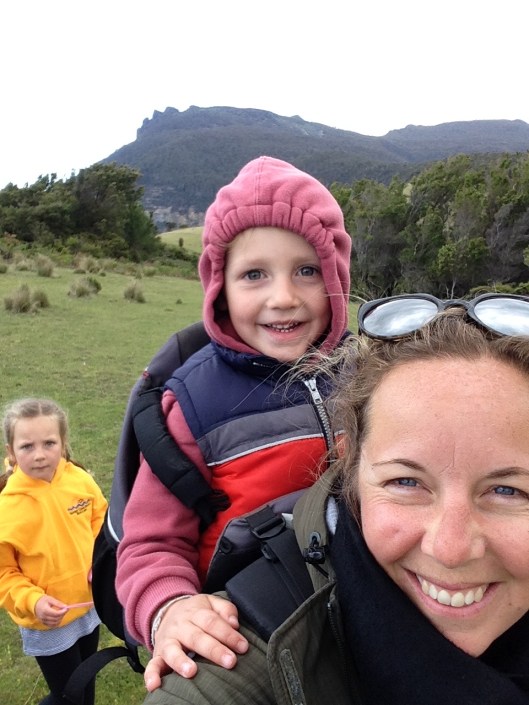
The Painted Cliffs circuit, 4.3km hike, was the second walk we tackled. The Painted Cliffs, at the end of Hopground Beach, are stunning cliffs with beautifully exposed patterns. The ground water percolating through the sandstone, leaving traces of iron oxides, has stained the rock formation to create these gorgeous cliffs, along with the mineral-rich water and wind, which has given it its shape.


One of the main reasons we went to Maria Island, was to see some of Australia’s native animals in their natural habitat. Before we arrived on the island, Alexis had a list of animals that live there, animals such as kangaroos, wallabies, wombats, Tasmanian devils and the rare and unique Cape Barren goose. We found many of these animals but much to Reid’s disappointment, we did not see a Tassie devil (‘Tassie double,’ as Reid calls it).


After a day at Maria Island, we drove to Coles Bay, 100km north of Triabunna. Coles Bay is a quiet seaside village on the edge of Freycinet National Park. The drive was stressful as we drove on winding, narrow roads through remote bush at dusk. The fear of hitting an animal was real as there were signs posted everywhere. We later learned that more animals are killed per km of road in Tasmania than anywhere else in the world, with an estimate of up to 500,000 animals killed a year.
Freycinet National Park is known for its rugged, pink-hued, granite peaks called the Hazards and is home to the world famous Wineglass Bay, a bay with sugar-white sand and beautiful turquoise-blue water. Our first full day in Coles Bay, we hiked the 2.5km return up the Hazards to the Wineglass Bay lookout to admire the spectacular view and the beauty of Wineglass Bay.


The hike took us twice as long as the sign suggested it should! Too many Tim Tam breaks!


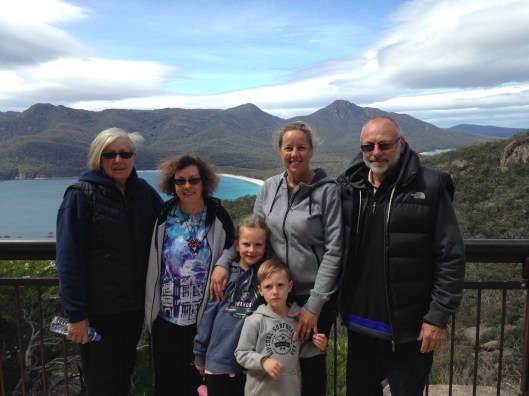

After the equally challenging hike down from Wineglass Bay lookout, we drove out to the Cape Tourville Lighthouse lookout where Opa saw a whale in the far off distance.


We drove back to our cottage in Coles Bay for lunch and a rest before heading out for dinner. We went to Tombolo Freycinet that evening and enjoyed delicious pizza with a spectacular view of the mighty, pink Hazards behind us.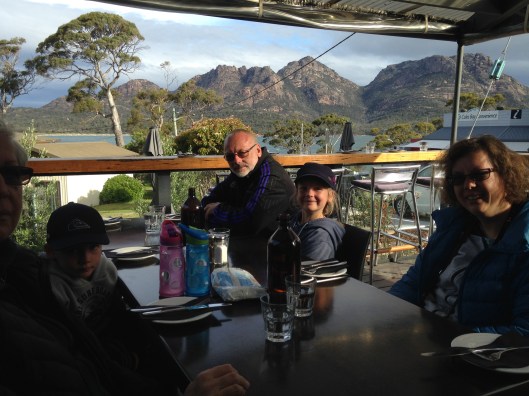
Later that evening, we drove to Bicheno from Coles Bay to view the fairy penguins. Just outside of Bicheno, there is a penguin rookery where the public can only access with a tour. Our guide took us down to the beach just after sunset to watch these beautiful creatures waddle out of the water and up to their burrows. We were lucky enough to see baby penguins in some burrows, waiting for their parents to come back. One baby even waddled out its burrow and between Oma’s feet!


The next day, we left Coles Bay and headed north to Nature World. Nature World is a wildlife sanctuary that offers a close up and interactive experience to learn about the unique Tasmanian animals.


The main reason for our visit was to see the greatly anticipated Tasmanian devil. We had no luck spotting one in the wild, so the wildlife sanctuary was the next best option. We were able to watch the keeper feed the devils, which was quite a show as two of them fought over one piece of meat for a long time.


Nature World is a place that focuses on the conservation of unique Tasmanian animals, such as the Tasmanian devil, as well as rescuing animals that have been injured or orphaned. We learned a lot about the devils and the wombats in particular, and also enjoyed viewing the beautiful birds as well as feeding the friendly kangaroos.


Baby wombats are very cuddly and friendly until they are about 2 yrs old. This baby wombat was brought to the sanctuary because he was an orphan and was happy to have a cuddle and a back scratch.


There is evidence of Tasmania’s convict past no matter where you go. Over 70,000 men, women and children were transported to Van Diemen’s Land in the early 1800s as convicts. It’s a story of crime, punishment, hardship and survival set in some of the most beautiful places on earth. For example, the Spiky Bridge, built by convicts in 1843, is made from field stones laid vertically, giving the bridge a spiky appearance. It is claimed that it was designed this way to prevent the cattle from falling over the edge, but no one really knows if this is true.


We continued driving north towards the Elephant Pass, a stunning drive inland and up a mountain to reach St. Mary’s. We stopped at the top to eat at the famous Mount Elephant Pancake Barn. We enjoyed delicious pancakes with ice cream and chocolate. However, we nearly had to do the dishes to pay for it as we discovered they only accept cash. Luckily, they have a system, where they give you an addressed envelope and when you drive through to St. Mary’s, you can take out money, put it in the envelope and post it to the Pancake Barn from there.
After lunch, we drove back down the mountain, back towards the coast and north to the Bay of Fires. This extraordinary part of Tasmania’s east coast may be the most beautiful coastline in the world. With miles of unspoilt, sugar-white sandy beaches with impossibly clear water, dotted with massive, brilliant orange-coloured granite boulders, it felt as if we were the only people around. This area was given the name Bay of Fires in 1773 by Captain Tobias Furneaux who saw the fires from the Aboriginal people on the beaches. We spent only a few hours exploring this coast but could have spent days there! 


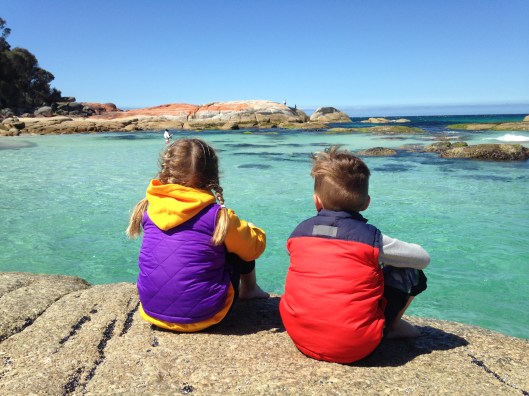
After having a play on the beach, climbing over the boulders and running from the waves, we carried on towards Launceston. We stayed two nights in Launceston, in a beautiful heritage property turned into a hotel. 
The highlight in Launceston for us was exploring the Cataract Gorge. The magnificent Cataract Gorge is a river gorge just a 10 minute wander from the city centre, however, the bushland, the cliffs and the ice-cold South Esk River here felt a million miles from town. 


We hiked the Cataract Walk from King’s Bridge up to First Basin. The walk was beautiful as it hugged the cliffs on one side and plunged to the mighty South Esk River on the other. To cross over the river at the First Basin, we took a chairlift. This chairlift travelled at a slow and leisurely pace so we could fully appreciate the stunning views. We then carried on to the Alexandra Suspension Bridge to cross back over the river and return to the Cataract Walk. What a beautiful place!


The next day, we drove to Hobart, the final destination of our Tassie road trip. That evening, we decided to venture into Hobart’s city centre. After a very stressful drive from the hotel to a downtown carpark (we had been driving through small country towns with no traffic for far too long), we wandered around the waterfront in search of Tasmanian fish and chips. We found ourselves in the famous Salamanca Square where we ended up at a brewery that served fish and chips as well as burgers, which kept everyone happy.


Sadly, our trip had come to an end. We enjoyed Tasmania, its beauty, the charming small towns, the unique wildlife and the fascinating history. The only thing we regret is that we didn’t have more time to explore and enjoy this naturally beautiful, laid-back treasure. 
 Janet Kuyvenhoven